Morpholino oligo(吗啉环寡聚核苷酸)由吗啉六元环与碱基通过非离子性磷酰二胺键(phosphorodiamidate)连接而成。相较于常用的磷硫酸酯(Phosphorothioate)及 PNA 类反义核酸,Morpholino 在效率、专一性与安全性方面均有显著优势,操作简便,价格更具竞争力。Morpholino oligos (MOs) consist of morpholine rings linked to bases via non-ionic phosphorodiamidate bonds. Compared with phosphorothioate and PNA antisense reagents, MOs offer superior efficiency, specificity and safety with simpler handling and competitive cost.
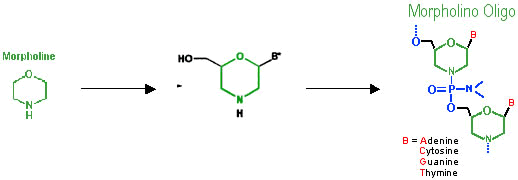
主要特点Key properties
- 稳定性高:具核酸酶抵抗性,在细胞内可稳定存留较长时间,不产生毒性裂解物。Stability: nuclease-resistant; stable in cells for extended periods without toxic degradation products.
- 效率高:作用浓度仅需纳摩尔级(nM)即可实现优越的抑制效果。Efficiency: effective at nanomolar concentrations.
- 不依赖 RNase H:通过空间位阻而非 RNA 降解途径发挥抑制作用,避免非目标 RNA 的非特异性裂解。RNase H-independent: steric-blocking mechanism, not RNA cleavage — avoids non-specific degradation of off-target RNAs.
- 序列专一性极高:专一性为磷硫酸酯类的 100 倍,高浓度下也不降低专一性。High specificity: 100× more sequence-specific than phosphorothioates; specificity maintained even at high concentrations.
- 结合力强:可侵入目标 RNA 的二级结构,实现稳定结合。Strong binding: can invade RNA secondary structures for stable hybridisation.
- 胞质与核内均有活性:可在两个区间发挥抑制作用,扩大适用范围。Dual compartment activity: functional in both cytoplasm and nucleus.
- 不受血清影响:不与血清中白蛋白结合,活性不受血清干扰。Serum-insensitive: does not bind serum albumin; activity unaffected by serum.
- 溶解度高:溶解度可达 100 mg/mL,保存过程中不易沉淀。High solubility: up to 100 mg/mL; stable in solution without precipitation.
- 长度最优:可合成至 25-mer,在目前市售反义核酸中最长,且长度增加不降低专一性。Optimal length: up to 25-mer — among the longest commercially available antisense oligos, with maintained specificity.
Morpholino 与 siRNA 对比Morpholino vs siRNA
| 特性Property | siRNA | Morpholino |
|---|---|---|
| 发表论文超过 500 篇Publications >500 | ✓ | ✓ |
| 允许干扰 pre-mRNA 剪接Splice-blocking capable | ✗ | ✓ |
| 在胚胎中有效且高度特异Effective & specific in embryos | ✗ | ✓ |
| 无脱靶效应No off-target effects | ✗ | ✓ |
| 无干扰素效应No interferon response | ✗ | ✓ |
| 初次靶向成功率高High first-attempt success | ✗ | ✓ |
| 胞质与核内均有活性Cytoplasm & nucleus activity | ✗ | ✓ |
| 完全稳定、长期有效Complete stability, long-term efficacy | ✗ | ✓ |
| 作用机制清晰Mechanism well understood | ✗ | ✓ |
序列设计要点Sequence design
| 要点Criterion | 具体要求Requirement | 说明Note |
|---|---|---|
| 靶向区域Target region | 5′ 帽下游至 AUG 后约 25 ntFrom 5′ cap to ~25 nt past AUG | 翻译阻断型;剪接干扰型靶向内含子-外显子交界处For translation block; splice MO targets intron-exon junction |
| 长度Length | ~25-mer | 较长特异性更高,价格不因长度增加而变化Longer = higher specificity; cost does not increase with length |
| GC 含量GC content | ≤ 36% | 过高 GC 导致二级结构,影响溶解性与活性High GC causes secondary structures, impairs solubility and activity |
| 内部互补Self-complementarity | ≤ 4 碱基 | 避免 MO 自身折叠影响与靶 RNA 的结合Prevents MO self-folding that reduces target binding |
递送方法Delivery methods
1. 显微注射(早期胚胎 / 卵母细胞)Microinjection (early embryo/oocyte)
- 适用:单细胞期或早期卵裂期胚胎,用量 0.5–2 pmol/胚胎。For single-cell or early cleavage-stage embryos; dose 0.5–2 pmol/embryo.
- 将 MO 溶液装入毛细玻璃针,在显微镜下注入动物极胞质或目标卵裂球。Load MO into glass capillary and inject into animal pole cytoplasm or target blastomere under microscope.
- 注射后在含 3% Ficoll 的溶液中恢复 1–2 h,再转入常规培养液。Recover injected embryos in 3% Ficoll solution for 1–2 h before transferring to normal medium.
2. 电穿孔(培养细胞 / 特定组织)Electroporation (cells/tissue)
- 适用:体外培养细胞(如 XC 细胞系)或特定时期的蝌蚪组织(尾部、视杯等)。For cultured cells (e.g. XC cell line) or specific tadpole tissues (tail, eye cup, etc.).
- 在方波电穿孔仪中施加特定电场(爪蟾胚胎常用 15–30 V, 50 ms/脉冲, 3–5 次),暂时打开细胞膜使 MO 进入。Apply square-wave pulses (15–30 V, 50 ms, 3–5 pulses) to transiently open the membrane and drive MO entry.
- 需优化电压与脉冲次数以平衡递送效率和细胞存活率。Optimise voltage and pulse number to balance delivery efficiency with cell viability.
3. Endo-Porter (贴壁细胞)(adherent cells)
- 将 MO 与 Gene Tools 专利试剂 Endo-Porter 按推荐比例混合,直接加入细胞培养基。Mix MO with Gene Tools' Endo-Porter reagent at the recommended ratio and add directly to culture medium.
- 通过内吞途径高效递送,递送率可达 85–90%;避免脂质体转染的细胞毒性。Endosomal delivery achieves 85–90% delivery rate without liposome-associated cytotoxicity.
4. Vivo-Morpholino (晚期蝌蚪 / 成体)(late tadpole/adult)
- 使用经特殊化学修饰的 Vivo-Morpholino,通过静脉注射或腹腔注射导入晚期蝌蚪或成体动物。Use specially modified Vivo-Morpholinos; deliver by intravenous or intraperitoneal injection into late tadpoles or adults.
- 成本较高,但为研究成体阶段基因功能的有效工具。Higher cost but effective for gene function studies in adult stages.
应用技巧与注意事项Tips & notes
- 效果验证:务必通过 Western Blot 检测目标蛋白表达下降,或 RT-PCR 检测剪接模式改变,以确认 MO 敲低效果。Validation: always confirm knockdown by Western blot (protein reduction) or RT-PCR (splice pattern change).
- 浓度梯度:初次实验建议设置浓度梯度,并设 Standard Control MO 阴性对照,排除非特异性发育缺陷。Dose titration: set concentration gradient in initial experiments; include Standard Control MO as negative control to exclude nonspecific developmental defects.
- 拯救实验:同时注射 MO 与经同义突变(不被 MO 识别)的 mRNA,观察表型能否恢复——这是验证特异性的金标准。Rescue experiment: co-inject MO with synonymously mutated mRNA (not recognised by MO) to test phenotype rescue — the gold-standard specificity assay.
- 光控 Morpholino:Photo-Morpholino(光裂解型)经 365 nm 紫外光照射后激活,可在特定时间或解剖区域精确控制基因敲低。Photo-Morpholino: photocleavable MOs are activated by 365 nm UV light, enabling spatiotemporally precise gene knockdown.
局限性Limitations
- 高浓度脱靶:浓度过高时可能非特异性影响其他基因,对照实验与表型验证至关重要。Off-target at high dose: non-specific effects possible at high concentrations; controls and phenotypic validation are essential.
- 需拯救实验验证:最严格的特异性验证是共注射 MO 与抗敲低 mRNA,观察表型能否被完全恢复。Rescue verification required: co-injection of MO with MO-resistant mRNA is the strictest specificity test.
- 半衰期较长:MO 在细胞内活性可维持数天,不适用于需要短期可逆敲低的实验;如需精确时空控制,建议使用 Photo-Morpholino。Long half-life: MO activity persists for days; not suitable for short-term reversible knockdown — consider Photo-Morpholinos for precise temporal control.
成功应用 Morpholino 的关键:根据实验阶段选择合适递送方法、遵循序列设计原则、设置严谨对照(Standard Control 或 5 碱基错配对照),并通过 Western Blot 与拯救实验多手段验证特异性。Keys to success: match delivery method to experimental stage; follow sequence design rules; use rigorous controls (Standard Control or 5-mismatch MO); validate specificity by Western blot and rescue experiment.
参考文献References
- Summerton J & Weller D (1997) Morpholino antisense oligomers: design, preparation, and properties. Antisense Nucleic Acid Drug Dev 7(3):187–195.
- Heasman J (2002) Morpholino oligos: making sense of antisense? Dev Biol 243(2):209–214.
- Blum M, et al. (2015) Xenopus, an undervalued model organism. Genesis 53(2):1–19.